Who Gets the House in an Alabama Divorce?
Neither spouse automatically gets the house in an Alabama divorce. Alabama divides marital property equitably, which means a fair division based on the circumstances rather than a guaranteed equal split of every asset. The result may involve selling the home, awarding it to one spouse, or negotiating another workable arrangement.
For many families, the home is both their largest asset and their largest monthly expense. A sound decision considers ownership, equity, debt, and the cost of maintaining the property after the divorce.
Is Alabama a 50/50 property division state?
Alabama law provides for equitable division of the marital estate. That does not require each spouse to receive half of the house or half of every account. The overall division matters. Alabama Code § 30-2-51 governs important aspects of property division.
A settlement might award one spouse the home while addressing the other spouse’s share through a payment or other property. Whether that arrangement is fair depends on the value and nature of the assets, the debts attached to them, and the family’s circumstances.
A house with substantial repair costs is not financially equivalent to cash in a bank account. A retirement account can also have restrictions and tax consequences that make a dollar-for-dollar trade misleading. Evaluate proposed trades before agreeing to them.
Who gets the house? Does it matter whose name is on the deed?
Yes, but the deed does not answer every divorce question. Title helps establish how the property is held. The divorce analysis also asks when and how the home was acquired, what funds were used, and how the property was used during the marriage.
A home purchased during the marriage with marital funds is not automatically beyond the court’s reach simply because only one spouse appears on the deed. Conversely, putting both names on a document does not guarantee that the final property division will be exactly equal.
Bring the deed, purchase closing documents, and mortgage records to your attorney. Those documents are more useful than assumptions based on who has usually made the monthly payment.
What if one spouse owned or inherited the house before the divorce?
Premarital property and property received by gift or inheritance require particular attention. Under § 30-2-51(a), the court generally cannot consider such property unless it finds that the property, or income it produced, was regularly used for the spouses’ common benefit during the marriage.
For example, regularly using a previously owned house as the family residence may raise different questions from keeping inherited property separate and unused by the family. The source of the purchase funds and the history of mortgage payments or improvements can also matter.
The common-benefit issue is fact specific. It does not create an automatic right to half of inherited property. Records tracing acquisition, use, and spending help the attorney assess what the court may consider.
What are the practical options for the marital home?
There are several possible approaches. Each needs clear terms.
Sell the home
A sale can pay off the mortgage and create proceeds available for division. The agreement should address selecting a listing agent, setting and adjusting the price, paying necessary expenses, and distributing the net proceeds.
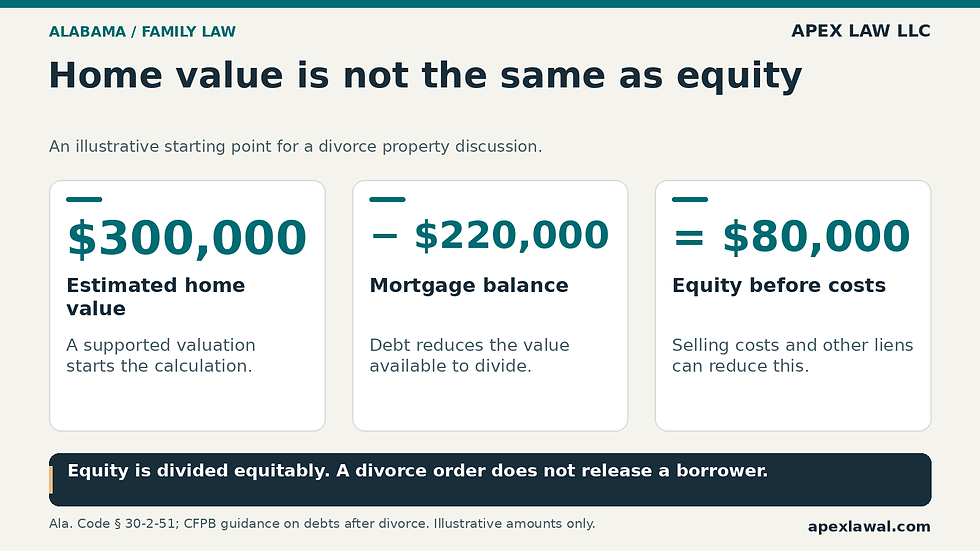
The expected sale price is not the amount available to divide. Mortgage payoffs, liens, closing costs, and other agreed expenses affect the final figure.
One spouse keeps the home
The spouse keeping the house may pay the other spouse an agreed amount or receive the house as part of a broader property settlement. The plan should address valuation, payment deadlines, title transfer, and any required refinancing or release from loan liability.
Before committing, investigate whether the proposed financing is realistic. A settlement that assumes a lender will approve a new loan can create problems if the application is later denied.
Delay the sale under a defined arrangement
Some families consider postponing a sale. If so, the arrangement should specify who lives there, who pays each expense, what triggers the sale, and how later equity will be divided.
Leaving these questions open can prolong financial ties and create disputes over repairs, missed payments, or changes in property value.
Does a divorce decree remove a spouse from the mortgage?
No. Assigning the mortgage to one spouse in a divorce does not automatically release the other borrower from the lender’s contract. Transferring the deed also does not remove a borrower’s name from the loan.
The Consumer Financial Protection Bureau explains that a creditor can generally continue collecting from a borrower despite a divorce decree assigning the debt to a former spouse.
A refinance, payoff, or lender-approved arrangement that expressly releases a borrower may be needed. Confirm the actual release requirements with the lender. An assumption or title change should not be treated as a release unless the relevant documents establish that result.
Your divorce agreement should also address what happens if the planned financing or release cannot be completed by the deadline.
Can one spouse stay in the house during the divorce?
A temporary living arrangement is a different question from final ownership. Alabama law permits appropriate temporary orders for exclusive use of the marital residence while a divorce is pending. Alabama Code § 30-2-8.1 specifically recognizes that type of relief.
An award of temporary occupancy does not itself decide the final property division. Discuss the current living arrangement and any existing orders with your attorney before changing locks, excluding a spouse, or making major decisions about the property.
Frequently asked questions about the house in a divorce
Does the parent with primary custody automatically keep the house?
No. The children’s needs and stability can be relevant to the family’s circumstances, but primary custody does not automatically transfer ownership of the home.
If I move out, do I lose my interest in the house?
Moving out does not by itself transfer your ownership interest. It can affect practical arrangements and the facts the court considers, so discuss your plan and any temporary orders with an attorney.
How do we determine the home’s value?
A supported valuation is preferable to a guess. Depending on the dispute, the parties may use an agreed valuation, market information, or an appraisal. Mortgage payoff information and other liens are also needed to assess equity.
Review your property options with Apex Law
Bring the deed, mortgage statement, any appraisal, and information about purchase funds and major improvements. Apex Law LLC can review the home as part of your overall Alabama divorce matter, with offices in Huntsville and Birmingham.
Call (256) 203-4290 or contact Apex Law to request a consultation. A 30-minute telephone consultation is $200. Consultation details.
This article provides general information about Alabama law. It is not legal advice for a particular case and does not create an attorney-client relationship.


Comments